Olivia Esqueda | Manager of Naturalists and Vessel Operations | October 15th, 2026 |
Boating around in the Salish Sea means you are traveling around in some of the richest waters in the entire world. An abundance of nutrients finds their way into this large inland sea and consistently gets stirred up filling these waters with a wealth of phytoplankton, which in turn supports the base of the extremely diverse trophic scale [organisms occupying the food chain]. This inland sea stretches north through the Strait of Georgia by the Campbell River and Desolation Sound and down towards Olympia, WA, including Rosario Strait, the Strait of Juan de Fuca, the Haro Strait, and the Puget Sound. The Salish Sea is so magically unique, it’s no surprise why humans and wildlife alike find themselves returning year after year.
Like many other ecosystems in the world, the Salish Sea has changed over the recent decades, and with it, we have seen a change in the wildlife that occupies this environment. Present day, the four main whales that frequent the Salish Sea include: Bigg’s Killer Whales [also known as Transient Orcas], Humpback Whales, Minke Whales and Gray Whales.
One of the biggest success stories within the Salish Sea is the return of the Humpback Whales! Commercial whaling severely reduced humpback whale numbers from historical levels and this caused a disappearance of these baleen whales within the Salish Sea. After almost 100 years, we saw the first return of Humpback Whales, and over the years have noticed a slight increase. It wasn’t until this most recent decade that we witnessed the biggest boom in numbers! According to the Pacific Whale Watch Association 2025 Sightings and Sentinel Actions Report [link below], Humpbacks were reported on 314 days of the 2025 season!
This data is extra exciting since Humpback Whales are a migratory species. This means they have separate feeding grounds versus breeding/birthing grounds. In winter, these whales travel to warmer waters such as the Hawaiian Islands, Mexico, and even Central America. The warm waters provide protection for their young, but not a lot of food. Therefore, they live off the fat reserves that they’ve built up during the summer months. Come spring, these whales return to nutrient rich, productive waters of the Salish Sea, British Colombia, and Alaska to spend the next few months eating as much as they can every day to then build up their fat reserves and start the process all over again.
Other potential migratory baleen whales we see in the Salish Sea include Minke Whales and Gray Whales. Minke Whales were reported on 154 days in 2025 (PWWA, 2025). While not considered to be endangered [they were often overlooked during the historical commercial whaling era due to their small size], not a lot is known about them, but photo identification studies estimate we have a population of around 30 individuals that forage in this area (Olsen et al. 2024). Additionally, Gray Whales were reported on 147 days of 2025 (PWWA, 2025). Over the decades, Gray Whales will stop in the Salish Sea for feeding as they migrate between Mexico and the Arctic.
But what about orcas!?
While the Southern Resident Killer Whales lead orca research for decades and made the San Juan Islands famous, unfortunately, visits to the Salish Sea are few and infrequent- think about a handful of times in a year. This is due to a lack of prey [primarily Chinook salmon] and a decrease in size of prey as well. Therefore, SRKW are expanding their historical range in search of more food, following other types of salmon runs, and have been listed as critically endangered. As of January 1st, 2025, a new law was passed increasing the approach distance for SRKW’s to 1,000 yards, which includes ALL vessels, not just commercial. While this orca population was once seen in the Salish Sea during the summer months, recent research shows their visits have altered to appear more so during the off season. While it is not impossible for you to see this population on your visit, it is sadly no longer to be expected. For more detailed information on the plight of the Southern Resident Killer Whales and our continued conservation efforts, please visit the links below.
Wait a moment- there are different types of orcas?! YES!
Note: The word species is a bit hard to define, and while each population of orca falls right in that category of being distinct species, for now, the word ecotype is being used to distinguish them apart from one another. It can be confusing but we will dive into it!
All around the world, as we continue orca research, we have come to learn there are upwards of 30 different ecotypes of killer whales. Over hundreds of thousands of years, each population has essentially divided from one another and became incredibly unique. Each population has its own region of which they can be found, feed on different foods, communicate in diverse languages [or dialects], interact often only with one another, practice unique hunting techniques, and some even subdivided into sub-populations. Overall, they outlay extremely distinct cultures!
Which means- they don’t even breed with other ecotypes! As new habitats and ecosystems developed, orca ancestors took advantage of this, encouraging speciation to develop- this is essentially when populations split. With that, everything continues to be learned behavior from matriarchs (mothers and grandmothers) where a generational evolution takes place. Although orcas may look similar around the world at first glance, there are distinct traits separating them visually and functionally.
Bigg’s Killer Whales began to diverge around 300,000 years ago and have one of the most distinct genomes and do not share a close or direct genetic lineage to other populations that cross into this same distribution such as Southern Resident Killer Whales, Northern Resident Killer Whales, or Offshore Killer Whales. Although all these ecotypes may cross paths, Bigg’s Killer Whales have remained reproductively isolated without interbreeding for hundreds of thousands of years. This reproductive isolation inhibited the species to breed with other populations due to geographical, behavioral, genetic, or physiological barriers, causing the formation of a new ecotype and thus making them genetically distinct.
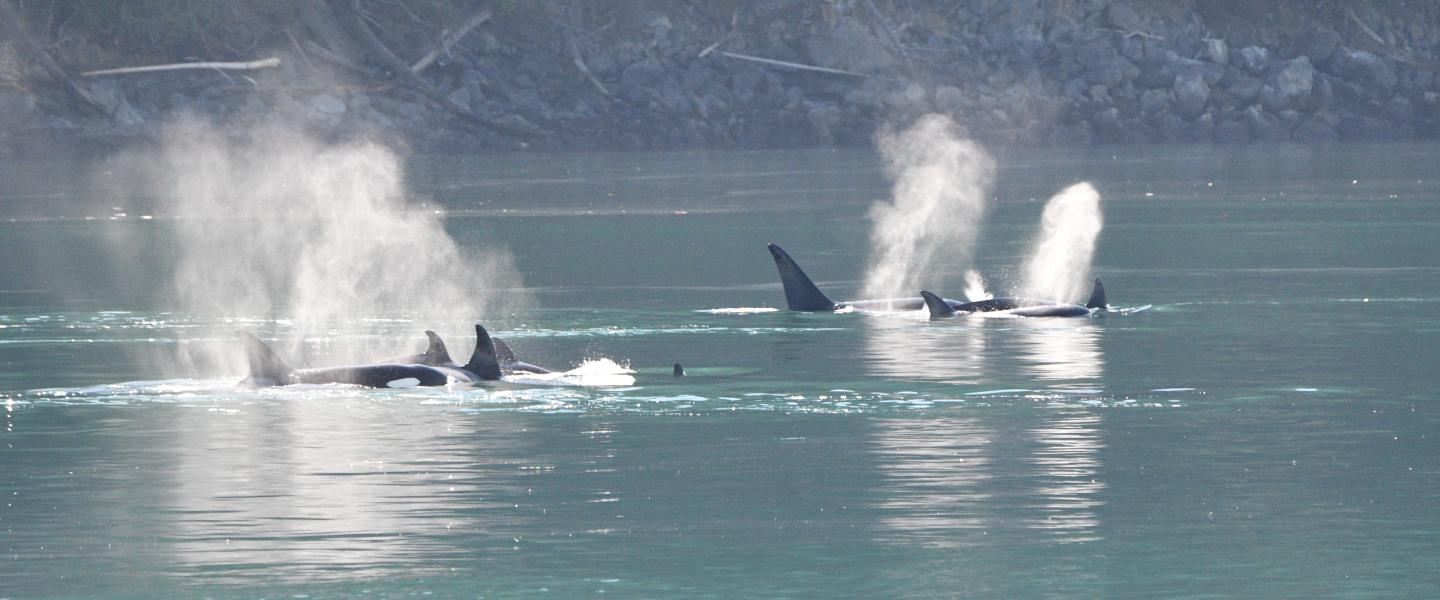
While the term transient is still true for this population, as they can be found anywhere from California up to Alaska [orcas do not migrate like baleens whales], transient and resident terms have become a bit confusing of what we see in front of us daily within the Salish Sea. Therefore, they are often referred to as Bigg’s Killer Whales after Dr. Michael Bigg who took that photo identification process and sent it flying in the late 80’s! This process is now used globally for many species to distinguish them as individuals. However, many folks will refer to these orcas simply as “the mammal eaters” since their preferred prey includes other marine mammals. While other orca ecotypes may feed on fish, skates, stingrays, and even sharks, this population only sees marine mammals as food- this all refers to that generational evolution of information passed down from mothers and grandmothers! This population has been not only growing at an exponential rate, but they have one of the largest population numbers of any other documented population, and one of the highest success rates of infants into adulthood. Long story short, they are considered one of the healthiest known populations and we are humbled to see it!
According to the 2025 PWWA data as well as Orca Behavior Institute, Bigg’s Killer Whales were present in the Salish Sea on 360 days of the year. Meaning, if you are seeing an orca, you are most likely seeing a mammal eater!
There is SO much to say about, well… so much! Stay tuned for more! Or better yet- come see, feel, smell, and listen for yourself!
Links
Learn more on our website here: https://www.sanjuansafaris.com/orca-whales
Pacific Whale Watch Association: https://www.pacificwhalewatchassociation.com/annualreports
Center for Whale Research: https://www.whaleresearch.com/
Orca Behavior Institute: https://www.orcabehaviorinstitute.org/