Lauren Tschirhart | May 25th, 2026 | M/V Osprey | 1:30 pm
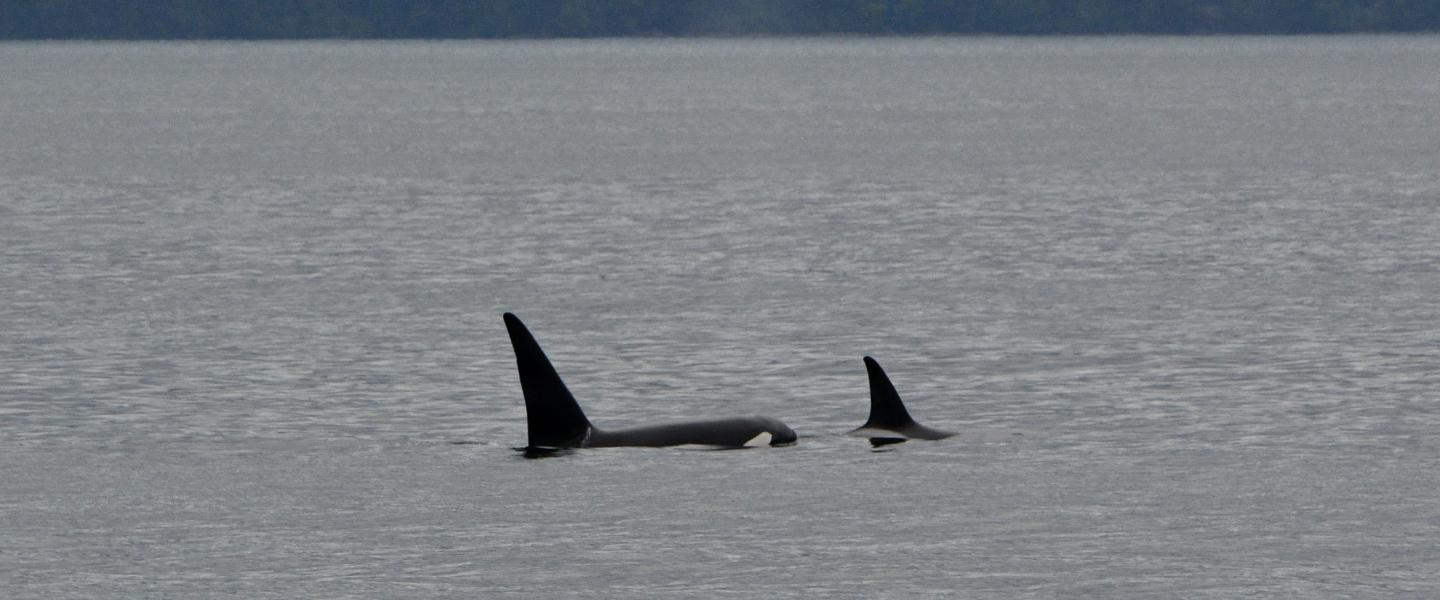
Just like humans, killer whales are visually all unique from one another. Also like humans, sometimes they have uncanny resemblances to one another. There are two whales in the Coastal Bigg’s population that are fairly hard to tell apart. Those whales are known as T123/ Stanley and T060C/ Yelnats, hence the name. Yelnats is Stanley spelled backwards. When identifying killer whales, you want to look for three types of distinct markings to figure out who you are looking at. The easiest way is to observe the size and shape of their dorsal fin. Looking for any nicks or notches on the trailing or back edge of the fin. Not all fins are obviously distinct, so if you can’t figure it out from the fin, you can also ID using their white oval shaped eye patches on each side of their heads. Lastly their saddle patches, the white or gray coloration just below their dorsal fin on their backs, are also distinct. Using these three identifiers, we can figure out exactly what individual we’re viewing. Hearing the reports come in that these twin boys and their families were traveling in close proximity to one another, I got my hopes up that I might see the doppelgängers socializing. I don’t believe I’ve ever seen those two families traveling together before. Although that’s not quite how things played out, we did get the opportunity to see these boys occupy the same waterway, at the same time, which was good enough for me!
Our day began by heading north, first stopping at Spieden Island to observe a deceased Stellar Sea Lion that was nourishing several birds of prey. We watched as several bald eagles, both adults and juveniles, as well as tons of turkey vultures feasted on this deceased pinniped. After the feeding frenzy, we continued northwest traveling into Canadian waters to catch up with the T123’s. We watched this family of four cruise north getting great looks at these traveling Apex predators. Suddenly in the distance we saw more dorsal fins start to break the surface of the water, finding out the T060s were not all that far away. We contemplated going to view the T060’s a bit closer, when a fellow Pacific Whale Watch Association (PWWA) vessel found a humpback also traveling in Swanson Channel! Humpback whales are also individually identifiable, but the easiest way to tell them apart is by looking at the bottom of their tail fluke. The humpback whale was identified as a male named BCY1176 “Moray” and he has a pretty cool history. He has been spotted in three different breeding and calving grounds! Moray is only 14 years old, so the fact he has been seen in Hawaii as well as Cabo San Lucas and Puerto Vallarta Mexico is pretty incredible! Females have a much higher site fidelity rate than males, so every once in a while, a male will go a bit rogue and decide they want to spread their genetics across the ocean basin. Boys will be boys am I right? Those aboard the M/V Osprey absolutely had a Memorial Day they will not soon forget.
Want to see more photos from our trips? Visit our SmugMug page at: https://sanjuansafaris.smugmug.com/